ChatGPT's memory went from a test to referencing every chat
OpenAI's own post, updated three times, traces memory from a small test to a system drawing on a user's full chat history.
- Historical event
- February 13, 2024
- First source published
- February 13, 2024
- Site publication
- September 18, 2026
What happened
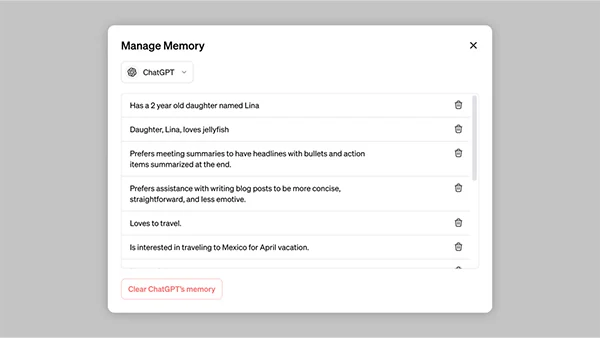
On 13 February 2024, OpenAI announced it was testing memory with ChatGPT for a small portion of free and Plus users, letting the system remember details volunteered across separate conversations so a user would not have to repeat them. The same page, treated by the company as a living update log rather than a one-off post, records memory reaching all Free, Plus, Team and Enterprise users on 5 September 2024, then becoming 'more comprehensive' on 10 April 2025 by referencing a user's past conversations generally rather than only explicitly saved facts, and reaching Free-tier users in a lighter form on 3 June 2025.
What the documents show
OpenAI's post distinguishes two mechanisms that later documentation keeps separate: 'saved memories,' details a user explicitly asks ChatGPT to remember, and 'chat history,' a broader synthesis the model draws on without being asked. The Memory FAQ, a help-centre page without its own publication date, explains the more recent design choice in practical terms: a visible 'memory summary' a user can read, edit by typing a correction, or delete outright, plus a separate 'sources' view that shows which memory shaped a specific reply. The FAQ also states that in regulated workspaces, such as ChatGPT for Healthcare, this improved memory is switched off by default and is not covered by the company's standard healthcare data agreement.
The mechanism
Saved memories function like a running, user-editable notepad attached to an account, consulted on every new chat regardless of topic. Chat history is different in kind: an automated synthesis process that OpenAI does not describe in architectural detail, updated continuously as a user talks to the model, which is what allows a memory summary to exist as a single readable document rather than a list of individually authored facts. Temporary Chat is the documented way to opt out of both mechanisms for a single conversation without changing account-wide settings.
What it leaves open
Neither document states how long a deleted memory persists in any backup or model-training pipeline before it is fully removed, only that deleting the memory itself, as opposed to the chat it came from, is required to remove it from future responses. The FAQ concedes the memory summary 'will not include everything ChatGPT remembers,' without stating what determines whether a detail is surfaced there or held invisibly. Editorially, a system that updates itself automatically is harder for a user to audit than one that only stores what they explicitly asked it to.
- If a memory summary is incomplete, what is the practical way to learn everything a system has inferred about you?
- Does turning memory off retroactively affect facts the model already inferred before the toggle was flipped?
- How should a workspace administrator explain to regulated users why improved memory is unavailable to them?
The steady widening recorded across four dated updates to one company page, from a small opt-in test to a background synthesis of a user's entire chat history, is itself the clearest evidence of how quickly a stated memory feature can change scope without a new product name attached to it.
Sources & reading trail
OpenAI's original memory announcement and its logged updates through 2025 expanding memory to reference full chat history.
Source published: 13 February 2024 · Retrieved: 16 September 2026
Living help-centre document describing current memory controls, the memory summary, and limits in regulated workspaces.
Source published: Not established · Retrieved: 16 September 2026
Company documents, filings, studies and official records establish the record; the reading and the questions are Lovebot Journal editorial analysis. This retrospective draft does not imply the site published on the event date.
Continue reading
- A paper gave chat agents an OS-style memory hierarchy
- Marketing calls it memory before docs explain it
- Browse the complete the archive
Sources & reading trail
- Memory and new controls for ChatGPT
Source published: February 13, 2024 · Retrieved: September 16, 2026 - Memory FAQ
Retrieved: September 16, 2026
The documents above establish the record. The reading and the questions are this publication’s editorial analysis, written after the fact.
Published September 18, 2026, not on the date of the event described.