A robot seal cleared US regulation years before its trial data arrived
A 2009 press release and a 2013 trial document PARO's FDA clearance and its measured effect on loneliness.
- Historical event
- September 21, 2009
- First source published
- November 4, 2009
- Site publication
- September 18, 2026
What happened
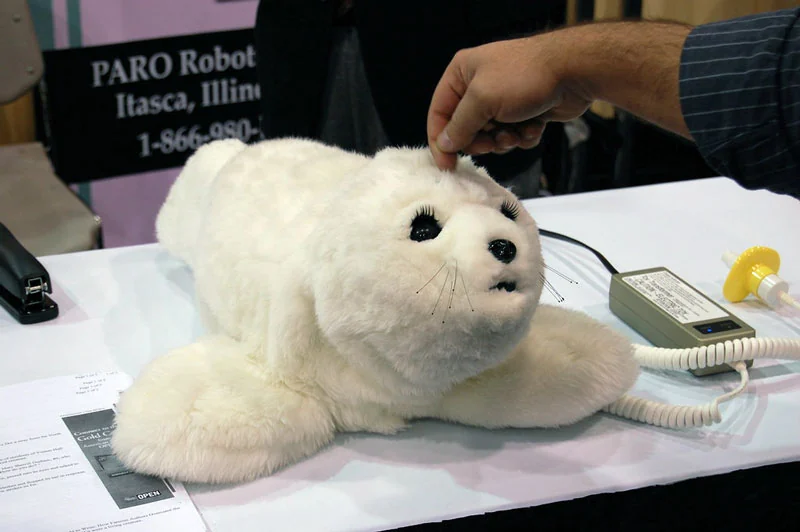
PARO, a robotic harp seal developed by Japan's AIST research institute, received US regulatory clearance in 2009. A press release dated 4 November 2009 states this 'follows receipt of Class II exempt pre-marketing notification from the Food and Drug Administration (FDA) on September 21, 2009,' with US sales and delivery beginning 1 December 2009 at $6,000 per unit including a one-year service warranty. Years later, a randomized controlled trial conducted in New Zealand tested the robot's effect on residents in aged care.
What the documents show
PARO's own product page describes it as the 'eighth generation of a design that has been in use in Japan and throughout Europe since 2003,' fitted with five sensors, tactile, light, audition, temperature, and posture, and certified by Guinness World Records as the 'World's Most Therapeutic Robot.' The 2009 press release records that during FDA pre-marketing review, the company loaned twenty units to hospitals, elder-care facilities, and schools for autistic children. Separately, a 2013 randomized controlled trial published in the Journal of the American Medical Directors Association tested 40 residents in a single Auckland rest home and hospital, running twice-weekly PARO sessions over 12 weeks; its abstract reports that residents assigned to the robot group showed 'significant decreases in loneliness' compared with a control group, and that residents talked to and touched the robot more than a resident dog kept at the same facility.
The mechanism
The FDA action and the clinical trial are different kinds of evidence and should not be conflated. A 'Class II exempt' notification is a regulatory classification confirming a device meets general controls for its category, chiefly a determination about electrical and biocompatibility safety, not a finding that the device treats any specific condition. The 2013 trial is a distinct, later piece of evidence testing one specific outcome, loneliness, in one specific 40-person population over a defined 12-week period; its abstract calls out loneliness as showing a significant effect without stating the same for the depression and quality-of-life measures it also collected.
What it leaves open
A single 40-person trial at one facility does not establish how PARO performs for other populations, over longer periods, or on outcomes the abstract does not report as significant. The company's own marketing language, invoking 'documented benefits of animal therapy' and a Guinness record, sits closer to promotion than to the narrower regulatory and clinical record described above.
- Does a device's regulatory clearance say anything about whether it treats a specific condition?
- Which outcomes did a cited trial report as statistically significant, and which did it simply measure?
- Can a single-site trial's result be generalized to a different population or care setting?
PARO's FDA clearance and its 2013 trial each document something real and specific; neither, on its own, supports the broader therapeutic claims a marketing page might imply from both together.
Sources & reading trail
Company's own description of PARO's origin at AIST, its sensors, and its generation history.
Source published: Not established · Retrieved: 16 September 2026
States the exact date of FDA Class II exempt pre-market notification and the US sales launch terms.
Source published: 4 November 2009 · Retrieved: 16 September 2026
Peer-reviewed RCT abstract reporting a significant reduction in loneliness among residents who interacted with PARO.
Source published: 1 September 2013 · Retrieved: 16 September 2026
Company documents, filings, studies and official records establish the record; the reading and the questions are Lovebot Journal editorial analysis. This retrospective draft does not imply the site published on the event date.
Continue reading
- LOVOT sells affection with a price tag and a required subscription
- Sony's aibo relaunch made ongoing ownership need a subscription
- Wellbeing studies on chatbots differ in size and funding
- Browse the complete the archive
Sources & reading trail
- The psychosocial effects of a companion robot: a randomized controlled trial
Source published: September 1, 2013 · Retrieved: September 16, 2026
The documents above establish the record. The reading and the questions are this publication’s editorial analysis, written after the fact.
Published September 18, 2026, not on the date of the event described.