Snapchat put a GPT-based friend in every user's chat list
Snap's own announcement and a later UK regulator notice describe My AI's rollout and a provisional risk-assessment finding.
- Historical event
- February 27, 2023
- First source published
- February 27, 2023
- Site publication
- September 18, 2026
What happened
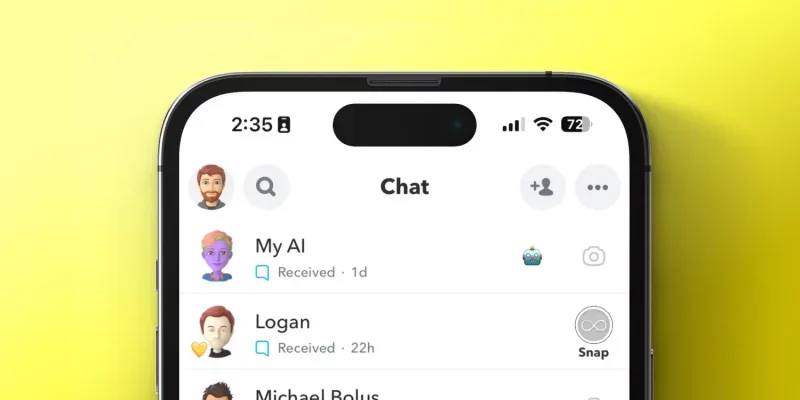
On 27 February 2023, Snap announced My AI, a chatbot built on a customised version of OpenAI's GPT technology, launching first as an experimental feature for Snapchat+ subscribers. The announcement lists everyday tasks the company positions it for: recommending a gift, planning a trip, suggesting a recipe. Snap then extended My AI to its wider Snapchat user base in the UK in April 2023, a rollout dated in a UK regulator's own account rather than in Snap's original post.
What the documents show
Snap's announcement is unusually direct about the product's limits at launch: it states that My AI 'is prone to hallucination and can be tricked into saying just about anything,' and advises users against sharing confidential information or relying on it for advice. It also discloses that conversations are stored for product improvement and describes a press-and-hold mechanism for flagging a bad response. A separate document, the UK Information Commissioner's Office's preliminary enforcement notice of 6 October 2023, adds detail Snap's own post does not: it records that My AI reached 21 million UK monthly active users by May 2023, and that the ICO's investigation provisionally found Snap's pre-launch risk assessment did not adequately address data-protection risks to users aged 13 to 17. The notice is explicit that its findings are provisional and that no breach of law had been established at that stage.
The mechanism
My AI's placement is itself the mechanism worth naming: rather than a chatbot a user opts to open in a separate app, Snap put it directly inside the same chat list as human friends, on a platform whose base is disproportionately teenagers. The ICO notice frames its concern specifically around that placement, not around the underlying GPT technology in the abstract — the regulator's stated question is whether Snap adequately assessed data-protection risk before large-scale deployment to minors, not whether a language model can converse.
What it leaves open
Because the ICO's findings were provisional as of the notice, and this record draws on nothing beyond what these two documents state, whether a final enforcement notice followed, and what it required, is outside what is confirmed here. Readers should also note the preliminary notice's page was not reachable at its published URL at the point of retrieval for this record and was instead read from an archived copy of the same document.
- Is a regulator's finding described as provisional, or as a final, binding determination?
- Does a company disclose how long conversations are stored and what they are used to improve?
- Where is an AI companion placed in an app's interface, and does that placement change who encounters it?
Snap's own words at launch already conceded the model would sometimes be wrong; the regulatory record adds a separate, procedural question about whether the risk of putting that fallible system in front of millions of teenagers was adequately assessed beforehand. Those are two different kinds of claim, and this record keeps them apart rather than treating one as evidence for the other.
Sources & reading trail
Announces My AI's launch to Snapchat+ subscribers and discloses hallucination risk and conversation storage.
Source published: 27 February 2023 · Retrieved: 16 September 2026
Provisional finding on risk-assessment adequacy for 13-17 year olds; records Feb/Apr 2023 rollout and 21 million UK MAU.
Source published: 6 October 2023 · Retrieved: 16 September 2026
Company documents, filings, studies and official records establish the record; the reading and the questions are Lovebot Journal editorial analysis. This retrospective draft does not imply the site published on the event date.
Continue reading
- OpenAI let users publish personas, then banned romantic ones
- A privacy review found every romantic chatbot it tested fell short
- Three companion privacy policies diverge on chat data
- Browse the complete the archive
Sources & reading trail
- Say Hi to My AI
Source published: February 27, 2023 · Retrieved: September 16, 2026 - UK Information Commissioner issues preliminary enforcement notice against Snap
Source published: October 6, 2023 · Retrieved: September 16, 2026
The documents above establish the record. The reading and the questions are this publication’s editorial analysis, written after the fact.
Published September 18, 2026, not on the date of the event described.