Turing replaced a question about thinking with a test of imitation
Turing's 1950 paper proposes an indistinguishability test rather than a definition of thinking, the frame every companion app's persona now inverts.
- Historical event
- October 1, 1950
- First source published
- October 1, 1950
- Site publication
- September 18, 2026
What happened
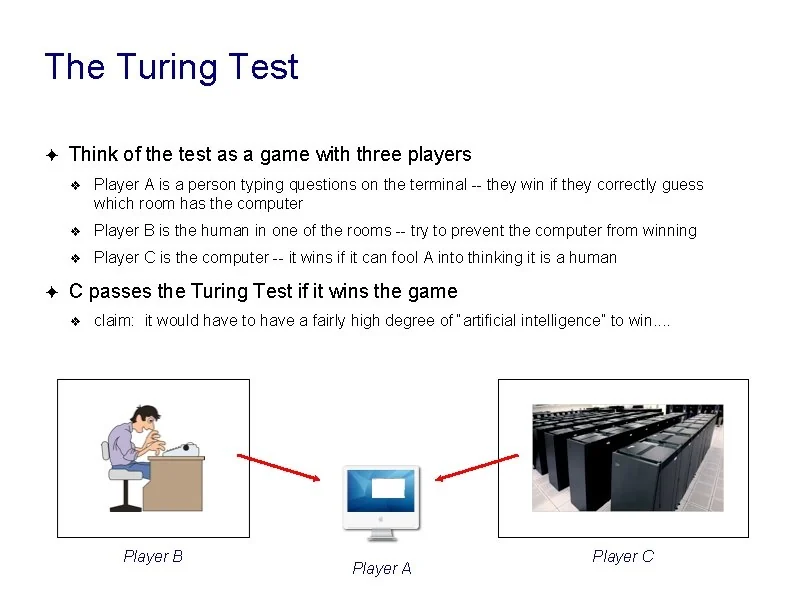
In October 1950 the journal Mind published Computing Machinery and Intelligence by A. M. Turing. The paper opens by setting aside the question 'Can machines think?' as too tied to disputed definitions of 'machine' and 'think', and replaces it with what Turing calls the imitation game: an interrogator questions two hidden respondents, one a person and one a machine, through typewritten notes, and tries to identify which is which. Turing proposes that a machine's success at causing wrong identifications, rather than any claim about its inner life, is what a working definition of machine intelligence should track.
What the documents show
The full text of the paper shows the game was originally about gender, not species: a man and a woman try to convince an interrogator of their sex, and Turing then asks what happens when a machine takes the man's part. He predicts that by the end of the century a computer with a large storage capacity could play the game well enough that an average interrogator would have no better than a 70 per cent chance of a correct identification after five minutes of questioning. He also states plainly that he believes the original question, 'Can machines think?', is 'too meaningless to deserve discussion' - the substitution is deliberate, not a simplification he regrets. The academic record of the paper confirms its publication details: Mind, volume 59, issue 236, pages 433 to 460.
The mechanism
The imitation game is a behavioural test built on concealment: the interrogator cannot see, touch or hear either respondent, so appearance and voice are excluded, and only the content of answers counts. A companion app inverts this concealment. The user is not trying to catch the system out; the product tells the user, in its onboarding and marketing, that they are speaking with software, and the design goal is not to pass undetected but to be worth returning to regardless. Persona, memory and responsiveness are aimed at a user who already knows the answer to Turing's question about the interlocutor and chooses to continue the conversation anyway.
What it leaves open
Turing's paper does not address sustained relationships, memory across sessions, or a user who wants to believe a persona is more than a pattern of replies - those are questions a companion app raises that the imitation game was never built to answer. Treating the game as a historical precedent for today's products is, here, an editorial framing rather than a claim in Turing's own text.
- Is a product asking to be mistaken for a person, or asking to be enjoyed while known to be software?
- What replaces 'indistinguishability' as a measure when the user is not trying to detect the machine?
- Does a claim about an app 'passing' any test actually specify the test's conditions?
Read this way, the 1950 paper is less a founding myth for chatbots than a still-useful caution: define the test before claiming the result, and say what a system is being compared against.
Sources & reading trail
Full text of the paper: the imitation game's rules, Turing's predictions, and his verdict on the original question.
Source published: 1 October 1950 · Retrieved: 16 September 2026
Confirms the official publication venue, volume, issue and page range for the paper.
Source published: 1 October 1950 · Retrieved: 16 September 2026
Company documents, filings, studies and official records establish the record; the reading and the questions are Lovebot Journal editorial analysis. This retrospective draft does not imply the site published on the event date.
Continue reading
- ELIZA showed people project understanding onto pattern matching
- A contest paid chatbots to seem human not to be right
- Google announced a dialogue model built for open-ended chat
- Browse the complete the archive
Sources & reading trail
- Computing Machinery and Intelligence
Source published: October 1, 1950 · Retrieved: September 16, 2026 - I.—Computing Machinery and Intelligence (Mind, Vol. LIX, No. 236)
Source published: October 1, 1950 · Retrieved: September 16, 2026
The documents above establish the record. The reading and the questions are this publication’s editorial analysis, written after the fact.
Published September 18, 2026, not on the date of the event described.