A small trial gave Woebot's chatbot claims their evidence template
A 70-person 2017 JMIR trial found reduced depression symptoms in college students using the Woebot chatbot for two weeks.
- Historical event
- June 6, 2017
- First source published
- June 6, 2017
- Site publication
- September 18, 2026
What happened
On 6 June 2017, JMIR Mental Health published Delivering Cognitive Behavior Therapy to Young Adults With Symptoms of Depression and Anxiety Using a Fully Automated Conversational Agent (Woebot): A Randomized Controlled Trial, by Kathleen Kara Fitzpatrick, Alison Darcy and Molly Vierhile. The paper reports a study recruiting through a social media flyer 'targeting a US university community for students who self-identified as experiencing symptoms of depression and anxiety', with 204 registrations received between 31 January and 20 February 2017 and 70 participants ultimately randomised.
What the documents show
The paper states participants were assigned either to Woebot, which delivered cognitive behavioural therapy content through daily conversations over two weeks, or to a control group given the National Institute of Mental Health's self-help ebook on depression. It reports the Woebot group 'significantly reduced their symptoms of depression over the study period' on the PHQ-9 scale (F=6.47, P=.01, a moderate effect size of d=0.44), while anxiety scores, measured by GAD-7, fell in both groups among those who completed the study. An archived 2017 page from Woebot's own site points directly at this same trial, telling visitors 'we conducted a randomized controlled trial at Stanford University', a company citing its own evidence rather than a marketing claim standing alone.
The mechanism
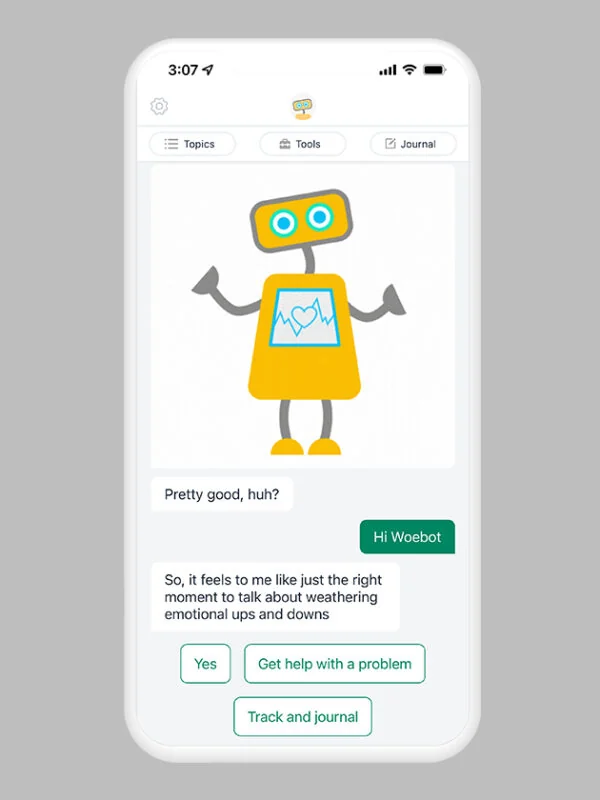
The trial tested a specific, narrow mechanism: scripted, daily, text-based delivery of established cognitive behavioural techniques, not general conversation or open-ended emotional support. The paper describes Woebot as tracking mood and delivering content contingent on it, which is closer to a structured digital worksheet with a conversational interface than to a companion persona meant to be enjoyed for its own sake. That distinction, between a delivery mechanism for a validated technique and a persona designed to hold attention, separates this record from most of the other companion products in this file.
What it leaves open
The trial ran for two weeks with 70 participants who self-identified their symptoms rather than being clinically diagnosed, and the paper does not claim durability beyond its short follow-up window; it also notes the study was exempt from public trial-registry listing because it involved a nonclinical population. Longer-term or larger replications sit outside the single document opened here.
- Does a wellness-app claim of being 'clinically studied' name the population, size and duration of that study?
- Was the outcome self-reported symptom change, or a clinical diagnosis made independently?
- Would the same result hold past the two weeks the trial actually measured?
Woebot's 2017 trial became a template partly because it was small and specific enough to run, and partly because the company kept pointing back to it rather than letting the claim of being 'research based' stand alone.
Sources & reading trail
Full trial design, sample size, recruitment dates, outcome measures and reported statistical results.
Source published: 6 June 2017 · Retrieved: 16 September 2026
Company's own 2017 site pointing directly at the Stanford trial as its evidentiary basis and describing the CBT-based product.
Source published: Not established · Retrieved: 16 September 2026
Company documents, filings, studies and official records establish the record; the reading and the questions are Lovebot Journal editorial analysis. This retrospective draft does not imply the site published on the event date.
Continue reading
- A 210-person trial tested a generative AI therapy chatbot
- A 2025 study pair found heavy chatbot use linked to worse outcomes
- An interview study described stages in a chatbot relationship
- Browse the complete the archive
Sources & reading trail
- Delivering Cognitive Behavior Therapy to Young Adults With Symptoms of Depression and Anxiety Using a Fully Automated Conversational Agent (Woebot): A Randomized Controlled Trial
Source published: June 6, 2017 · Retrieved: September 16, 2026 - Woebot - Your charming robot friend who is ready to listen, 24/7 (archived August 2017)
Retrieved: September 16, 2026
The documents above establish the record. The reading and the questions are this publication’s editorial analysis, written after the fact.
Published September 18, 2026, not on the date of the event described.