ElevenLabs builds agent voices on a self-attested consent claim
ElevenLabs' documentation and terms describe agent voices, cloning, and the consent language that governs them.
- Site publication
- September 18, 2026
What happened
ElevenLabs sells a platform for building conversational voice agents, documented on an ongoing basis rather than tied to one launch date. Its developer documentation, its public site, and its terms of use together describe a company that sells both voice cloning and agent deployment as separate, combinable products. This description reflects those pages as retrieved on 16 September 2026.
What the documents show
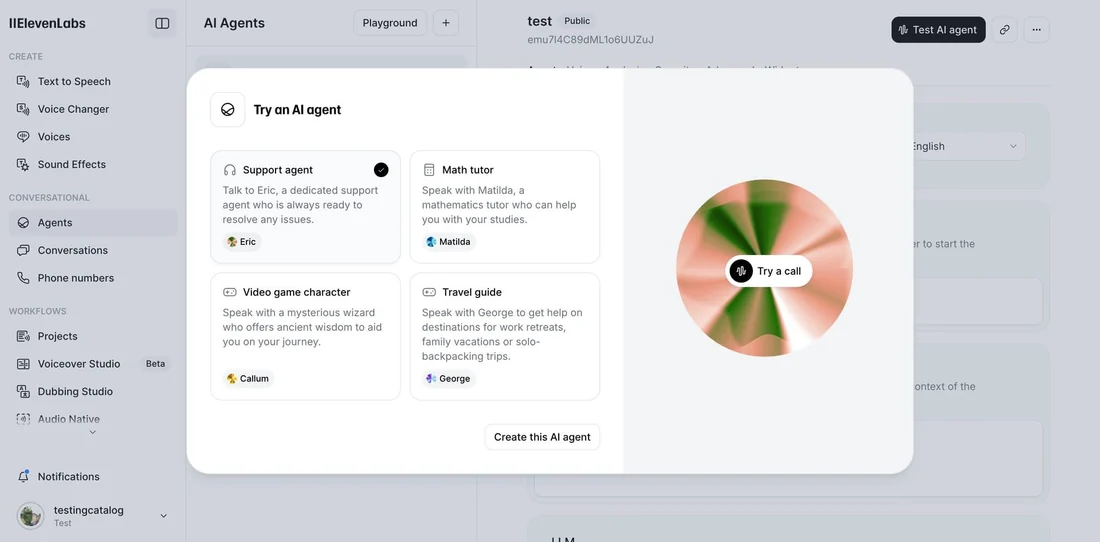
The homepage lists voice cloning as a feature of its creative tools: 'Clone your voice, design one from a prompt, or explore 10,000+ voices from the library.' The agent documentation describes a separate product, stating that agents 'accomplish tasks through natural dialogue' and can draw on uploaded documents through retrieval for grounded answers, offering a choice from '5k+ voices across 31 languages.' The terms of use set the conditions for supplying a voice: a user 'may be asked to upload audio recordings of your voice or the voice you are authorized to share with us,' and separately state that a user 'may not provide Input or create Output for which you do not have all the rights necessary to grant us the license described above.' The same document states that ElevenLabs 'will not commercialize your voice on a standalone basis without your permission.'
The mechanism
The consent structure here rests on self-attestation rather than independent verification: the terms ask an uploader to confirm they are 'authorized' to share a given voice, but the pages reviewed do not describe a step that checks that claim against the actual speaker before cloning proceeds. A companion app built on this platform inherits whatever consent chain was used upstream. That is a different object from a licensed voice, individually contracted with a named person, and different again from a voice 'designed from a prompt,' which is synthetic and modeled on no specific real person at all. All three can sound similarly natural to a listener while resting on entirely different permission structures.
What it leaves open
The documents reviewed do not describe a verification mechanism, such as a recorded consent statement matched against the uploaded audio, beyond the written attestation requirement in the terms. Whether such a step exists elsewhere in the product is not established by the pages opened here.
- Was a given synthetic voice cloned from a real person, licensed from them individually, or generated from a text prompt?
- If cloned, what verified the uploader's claim to be authorized to use that voice?
- Does the platform's own documentation distinguish these three cases anywhere a user would see it?
A natural-sounding agent voice does not, on its own, tell a listener which of these consent paths produced it, and the terms place the burden of that distinction on the uploader's word.
Sources & reading trail
Documents the agent architecture, voice selection and knowledge-base features, as retrieved.
Source published: Not established · Retrieved: 16 September 2026
States the consent, authorization and licensing terms that govern uploaded voice data.
Source published: Not established · Retrieved: 16 September 2026
States voice cloning as a distinct product feature alongside agent deployment.
Source published: Not established · Retrieved: 16 September 2026
Company documents, filings, studies and official records establish the record; the reading and the questions are Lovebot Journal editorial analysis. This retrospective draft does not imply the site published on the event date.
Continue reading
- Hume's voice interface says it measures expression, not emotion
- Meta gave its assistant five actors' licensed voices, not clones
- Sesame published its method for a voice that feels present
- Browse the complete the archive
Sources & reading trail
- ElevenAgents
Retrieved: September 16, 2026 - ElevenLabs Terms of Service (non-EEA)
Retrieved: September 16, 2026 - Free AI Voice Generator & Voice Agents Platform | ElevenLabs
Retrieved: September 16, 2026
The documents above establish the record. The reading and the questions are this publication’s editorial analysis, written after the fact.
Published September 18, 2026, not on the date of the event described.