Hume's voice interface says it measures expression, not emotion
Hume's own documentation describes prosody measurement and an empathic model, not detection of felt emotion.
- Historical event
- March 25, 2024
- First source published
- March 25, 2024
- Site publication
- September 18, 2026
What happened
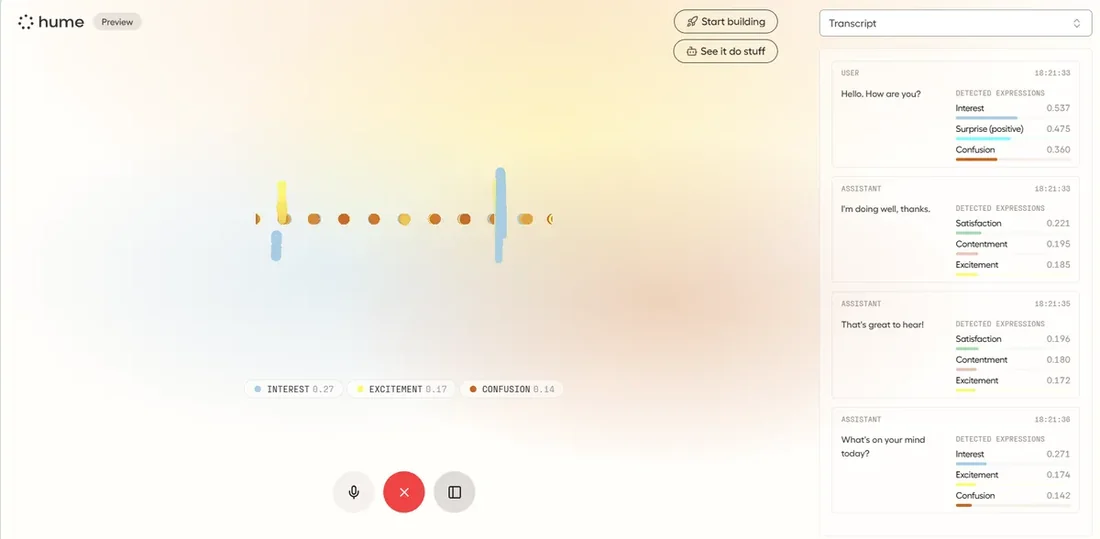
On 25 March 2024, Hume AI unveiled its Empathic Voice Interface (EVI), announced together with a Series B funding round. The company describes EVI as built on an 'empathic large language model' (eLLM), a system that pairs language generation with what it calls expression measurement. Three weeks later, on 18 April 2024, Hume opened EVI's API to developers, moving the product from demonstration to a buildable platform.
What the documents show
Hume's developer documentation states that EVI 'processes the tune, rhythm, and timbre of speech' and returns 'streaming measurements' from what it calls its prosody model, alongside a text transcript. The launch post adds that the system is 'trained on human reactions to optimize for positive expressions like happiness and satisfaction' and contrasts itself with a conventional assistant that 'stitches together transcription, LLMs, and text-to-speech.' Neither document states what the prosody model was trained to predict against, whose judgments defined a 'positive expression,' or what error rate the measurements carry. The documentation is a living product page, and this description reflects it as retrieved on 16 September 2026, so particular claims may since have changed.
The mechanism
Hume's own term, 'expression measure,' is doing real work and is worth preserving rather than collapsing into 'emotion detection.' Tune, rhythm and timbre are measurable acoustic properties of a sound wave. A felt emotion is not directly observable at all; it is inferred, here from a model trained against some labelled reference the documents do not name. An expression measure is therefore a correlation claim, that a vocal pattern tends to co-occur with a labelled category in Hume's data, not a claim that the system has detected what a speaker feels. The eLLM then shapes its reply to that measured pattern, which is a design choice about response style, separate from any claim of access to a user's internal state.
What it leaves open
The documentation does not disclose the reference data, raters, or validation accuracy behind the prosody model. It is editorial reading, not a claim Hume makes, that a product marketed as 'emotionally intelligent' invites more confidence in diagnostic precision than an acoustic pattern-match can support on its own.
- Does the product's own language distinguish measuring vocal patterns from inferring an internal emotional state?
- What reference data or human raters validated an expression measure, and is that published anywhere a reader can check?
- Can a user or reviewer see the confidence behind a given measurement, or only the output category it produced?
EVI names its measurement method more plainly than many competing voice products do, which makes it a useful case rather than a uniquely worrying one. The gap between a prosody measurement and genuine emotional understanding is not particular to Hume; it is a distinction worth applying to any companion app that markets itself as understanding how a user feels.
Sources & reading trail
Announces EVI's public unveiling and describes the eLLM architecture and training approach.
Source published: 25 March 2024 · Retrieved: 16 September 2026
Living documentation describing EVI's prosody-based expression measurement and streaming architecture.
Source published: Not established · Retrieved: 16 September 2026
States the API's general availability and the claim that EVI differs from a stitched transcription-LLM-TTS pipeline.
Source published: 18 April 2024 · Retrieved: 16 September 2026
Company documents, filings, studies and official records establish the record; the reading and the questions are Lovebot Journal editorial analysis. This retrospective draft does not imply the site published on the event date.
Continue reading
- Kyutai's Moshi model can listen and speak at the same time
- Sesame published its method for a voice that feels present
- ElevenLabs builds agent voices on a self-attested consent claim
- Browse the complete the archive
Sources & reading trail
- Hume Raises $50M Series B and Releases New Empathic Voice Interface
Source published: March 25, 2024 · Retrieved: September 16, 2026 - Speech-to-Speech (EVI)
Retrieved: September 16, 2026 - Introducing Hume's Empathic Voice Interface (EVI) API
Source published: April 18, 2024 · Retrieved: September 16, 2026
The documents above establish the record. The reading and the questions are this publication’s editorial analysis, written after the fact.
Published September 18, 2026, not on the date of the event described.