VRM and Live2D encode different rules for who owns a digital face
The VRM specification and Live2D's licenses show how differently each format records who may use an avatar.
- Site publication
- September 18, 2026
What happened
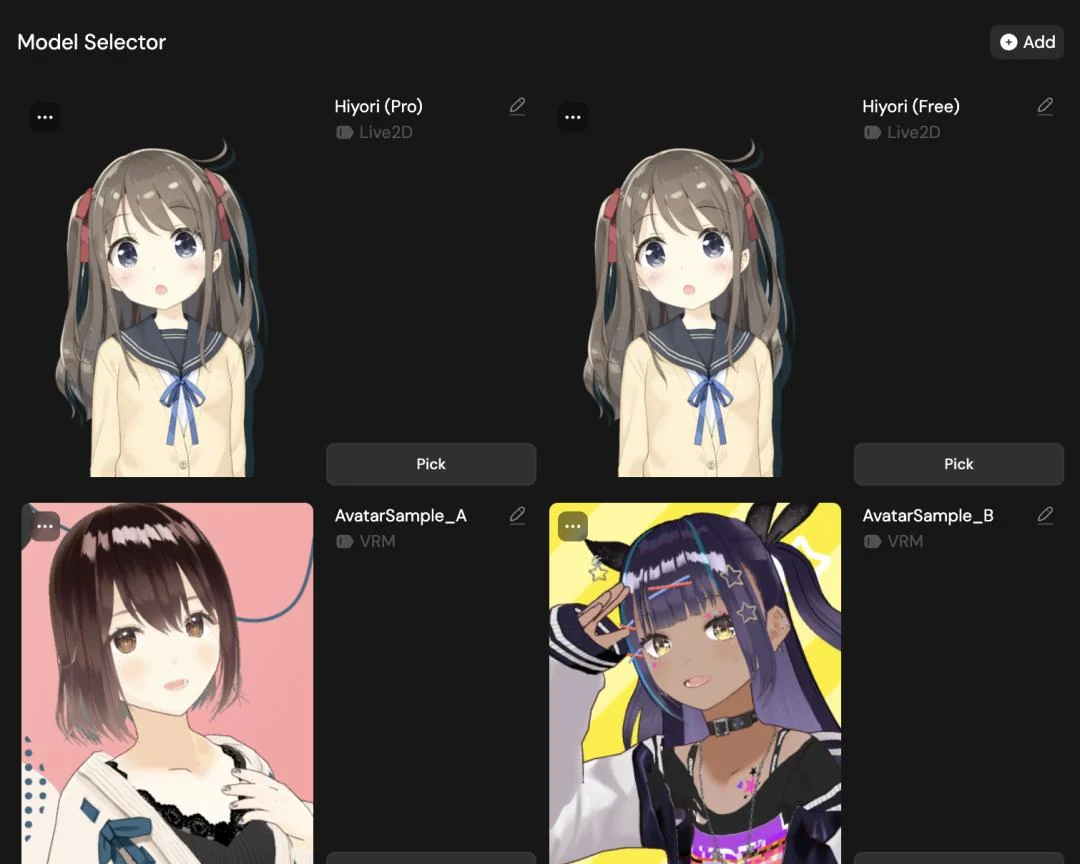
Two file formats let a companion app's visual character move between different pieces of software: VRM, a specification maintained by the VRM Consortium, and Live2D, a commercial rigging tool. The VRM Consortium's own site states that VRM is a cross-platform, glTF-based humanoid avatar format, while Live2D's own site describes software that 'directly animates your original drawings' in two dimensions. Both remain actively maintained, and this description reflects them as retrieved on 16 September 2026.
What the documents show
VRM's own overview states its purpose plainly: 'you can share the same avatar (3D model) data between VRM-compatible applications,' listing live streaming, VR games, and chat as example destinations, and notes an official Unity plugin exists for creators. The specification's metadata documentation lists specific required and optional fields carried inside a VRM file itself, including a required licenseUrl, an avatarPermission field controlling who may perform as the avatar, a commercialUsage field distinguishing personal non-profit, personal profit, and corporate use, and separate boolean flags covering violent, sexual, political, and redistribution permissions. Live2D's homepage, by contrast, describes governing use through separate agreements, a 'Software License Agreement,' a 'Free Material License Agreement,' and others, rather than fields embedded in the character file itself.
The mechanism
The key difference the documents establish is where usage rules live. A VRM file carries its own machine-readable permission fields as part of the asset, so the same file can, in principle, declare its rules to any compliant viewer it is loaded into, independent of which company's app opened it. Live2D instead rigs a two-dimensional illustration and leaves the terms of use in separate license agreements between the parties, outside the asset file, meaning enforcement and permission tracking depend on which agreement governs a particular use rather than on data traveling with the model itself.
What it leaves open
Neither source describes what happens if a viewer simply ignores a VRM file's declared permissions; the specification is descriptive metadata, not an access-control mechanism enforced by any particular software. Nor do the documents reviewed describe an actual case of a user recovering and reusing an avatar after a companion app's shutdown, only the technical capacity for a file to carry that information.
- Does an avatar format carry its own permission data, or rely on separate license agreements to govern reuse?
- What compliant software would actually read and respect a VRM file's declared usage permissions?
- If a companion app shut down, could a user's avatar file be verified to work anywhere else in practice?
A portable file format is a necessary condition for an avatar to outlive one company's app, but the documents here describe that capacity, not a demonstrated instance of it happening.
Sources & reading trail
States VRM's purpose as a cross-platform glTF-based humanoid avatar format portable between applications.
Source published: Not established · Retrieved: 16 September 2026
Specifies the license and usage-permission fields (avatarPermission, commercialUsage, allowRedistribution, and others) embedded in a VRM file's metadata.
Source published: Not established · Retrieved: 16 September 2026
Describes Live2D's 2D rigging technology and its separate software and content license agreements.
Source published: Not established · Retrieved: 16 September 2026
Company documents, filings, studies and official records establish the record; the reading and the questions are Lovebot Journal editorial analysis. This retrospective draft does not imply the site published on the event date.
Continue reading
- Replika layered its avatar onto a room through AR and VR headsets
- Gatebox's hologram companion became a licensed-character display maker
- A companion robot went silent when its maker closed
- Browse the complete the archive
Sources & reading trail
- What is VRM ? What can VRM do ?
Retrieved: September 16, 2026 - vrm-specification/specification/VRMC_vrm-1.0/meta.md at master
Retrieved: September 16, 2026 - Live2D Cubism | See your creation come to life.
Retrieved: September 16, 2026
The documents above establish the record. The reading and the questions are this publication’s editorial analysis, written after the fact.
Published September 18, 2026, not on the date of the event described.