Meta let anyone build a labelled AI character across its apps
Meta's AI Studio announcement and its 2026 shutdown notice show how a creator-AI feature launched, spread and was later retired.
- Historical event
- July 29, 2024
- First source published
- July 29, 2024
- Site publication
- September 18, 2026
What happened
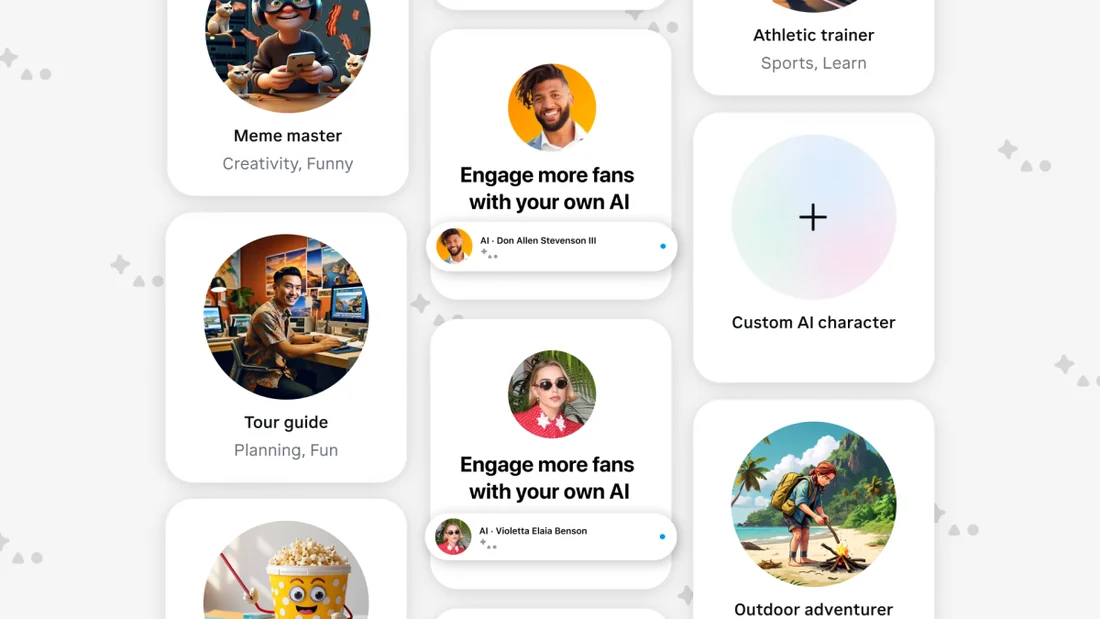
On 29 July 2024 Meta announced AI Studio, a tool built on Llama 3.1 that let anyone in the United States create a chat character and let Instagram creators build an AI version of themselves. A person could open a template or start from a blank prompt, then set a name, personality, tone, avatar and tagline; the finished character could be kept private or shared across Instagram, Messenger, WhatsApp and the web. Separately, a creator could switch on an AI extension of their own account, tuned on their content, to answer routine direct messages and story replies while they were away.
What the documents show
Meta's post lists real examples: a chef's dining-etiquette character, a photographer's lens-advice bot, a pet advocate's affirmation dog. It states plainly that responses from creator AIs 'are clearly labeled, so there's full transparency for fans,' and that creators could restrict topics and choose who the AI replies to from a professional dashboard. The same page has since been updated twice more. An entry dated 10 August 2026 says people can no longer create or edit AI Studio characters, because the company is directing its effort toward the next generation of experiences powered by Muse Spark. A separate April 2026 announcement describes Muse Spark as the underlying technology behind a faster, more conversational Meta AI assistant, distinct from a marketplace of user-built characters.
The mechanism
AI Studio's characters were not separately trained models. They were persona configurations layered on Meta's existing language model: a name, a tone and a set of allowed or restricted topics, applied at the point a user or fan opened a chat. The labelling that Meta describes is a product decision, not a legal mandate, and it applied only to creator-extension replies rather than to every fan-made character on the platform. Distribution followed Meta's own surface area, so a character's reach depended on Instagram, Messenger and WhatsApp rather than an open web address of its own.
What it leaves open
The original announcement does not describe what happened to a user's conversation data once a character was archived, nor does it explain how a fan distinguishes a labelled creator AI from an unlabelled fan-made one within the same app. Two years after launch, the company's own update shows the product's creation tools folded into a newer, centrally designed assistant rather than continuing as an open catalogue of characters. Whether that reflects thin usage, safety pressure or a strategic shift toward one branded assistant is, editorially, not something either document states.
- Who can still see or export a character built during AI Studio's active years?
- Does a 'clearly labeled' reply carry the same label wherever the character is embedded?
- What happens to a companion feature's users when the parent company redirects investment elsewhere?
AI Studio's two-year run, from open creation tool to a frozen archive of existing characters, is a small but concrete record of how quickly a companion feature can move from an experiment to a legacy setting inside a much larger product.
Sources & reading trail
Meta's own announcement of AI Studio, its creation flow, creator-AI labelling and later 2026 discontinuation notice.
Source published: 29 July 2024 · Retrieved: 16 September 2026
Describes Muse Spark, the successor technology Meta names as the reason AI Studio's character-creation function was retired.
Source published: 8 April 2026 · Retrieved: 16 September 2026
Company documents, filings, studies and official records establish the record; the reading and the questions are Lovebot Journal editorial analysis. This retrospective draft does not imply the site published on the event date.
Continue reading
- Meta hired celebrities to voice AI characters, then moved on
- A new law sets a timer on AI disclosure, not just wording
- Browse the complete the archive
Sources & reading trail
- Create Your Own Custom AI With AI Studio
Source published: July 29, 2024 · Retrieved: September 16, 2026 - Introducing Muse Spark, from Meta Superintelligence Labs
Source published: April 8, 2026 · Retrieved: September 16, 2026
The documents above establish the record. The reading and the questions are this publication’s editorial analysis, written after the fact.
Published September 18, 2026, not on the date of the event described.